



Every few years, games journalism announces its own rebirth.
A new website or publication launches. Some generic mission statement promises readers independence. Subscriptions replace ads. Corporate influence is supposedly left behind. And we’re told that this time will finally be different, more honest, more authentic, and more connected to the people who actually play games.
And then you look at the bylines.
Aftermath, the latest “independent” games media startup, is trying to position itself as some sort of “clean break” from the failures of legacy outlets like Kotaku, Polygon, Vice, and The Verge…but scratch the surface for about five seconds and you might find that a different picture starts to emerge.
This is not a revolution. It’s more like a reunion tour.
Same rejected writers. Same cringeworthy worldviews. Same self-aggrandizing echo-chamber social circles. Same exact audience disconnect that gamers already pushed back against.
Just without a familiar corporate logo at the top of the page.
Independence Part 2: eLECTRIC bOOGALOO
Aftermath bills itself as yet another worker-owned, reader-supported alternative to traditional games media, free from ad pressure, free from corporate mandates, and free to pursue “honest” coverage. On paper, that sounds almost noble. Hell, it sounds like it would be necessary in an industry that has been gutted by layoffs and buyouts in recent years.
But independence alone doesn’t make something sparkly and new.
And it definitely doesn’t make it relevant.
What Aftermath actually represents is not a clean break from the past. It’s more like a raging exodus of the collapsed media class. These are journalists who came up under the same corporate umbrellas, internalized the same editorial norms, and are now attempting to rebuild the same activist-driven content mill without even taking a second to ask gamers why they stopped paying attention to them in the first place.
A Masthead That Feels Strangely Familiar
Take a look at Aftermath’s founders and contributors and you will notice a recurring theme: legacy games media backgrounds. All of them.
Kotaku. IGN. Polygon. Vice. The Verge. Wired. The Guardian. Former G/O Media properties like Gizmodo and Deadspin. Vox Media. Ziff Davis.
It’s all there.
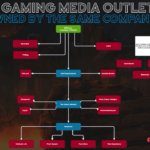
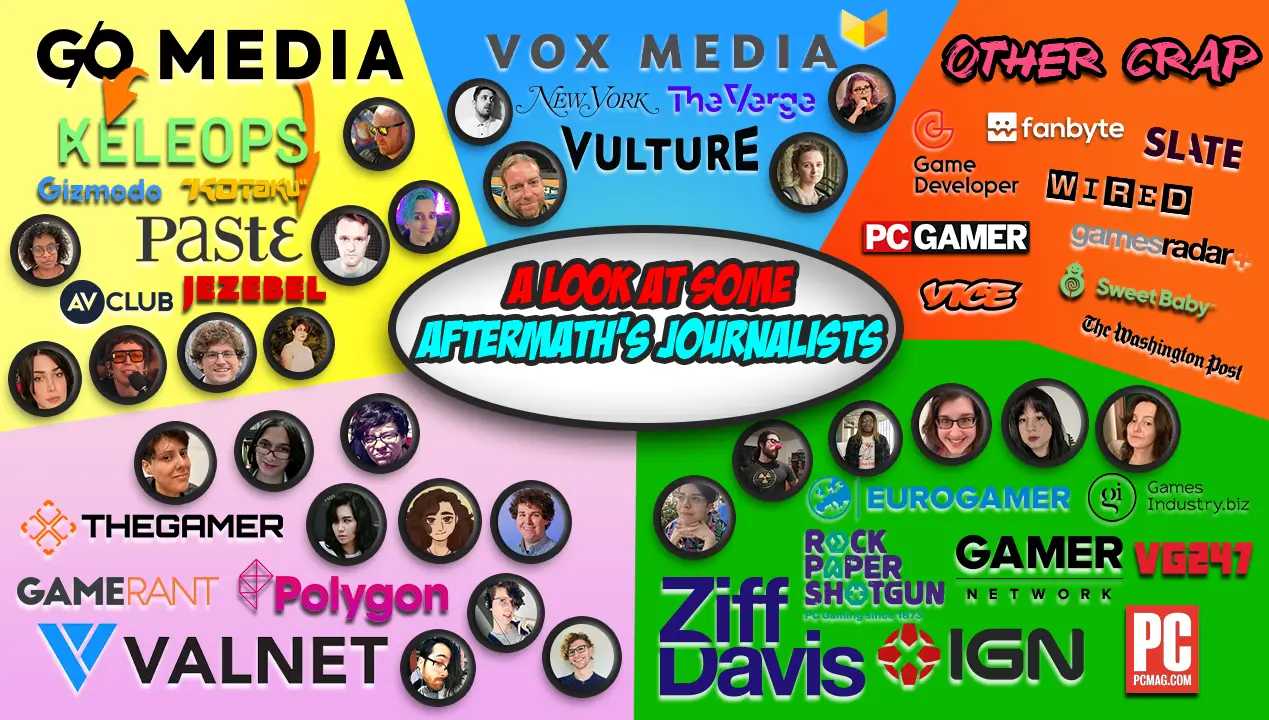
If you take a look at the cursed diagram below, I started trying to demonstrate the connections between journalists and the publications that they’ve written for – simply to give you a better idea of why you might find yourself thinking “why does everything I read in games publications sound the same?”.
However, due to space constraints and seemingly endless overlap, this still doesn’t even come close to painting the full picture of just how integrated these ideologically-motivated activists “journalists” are into gaming.
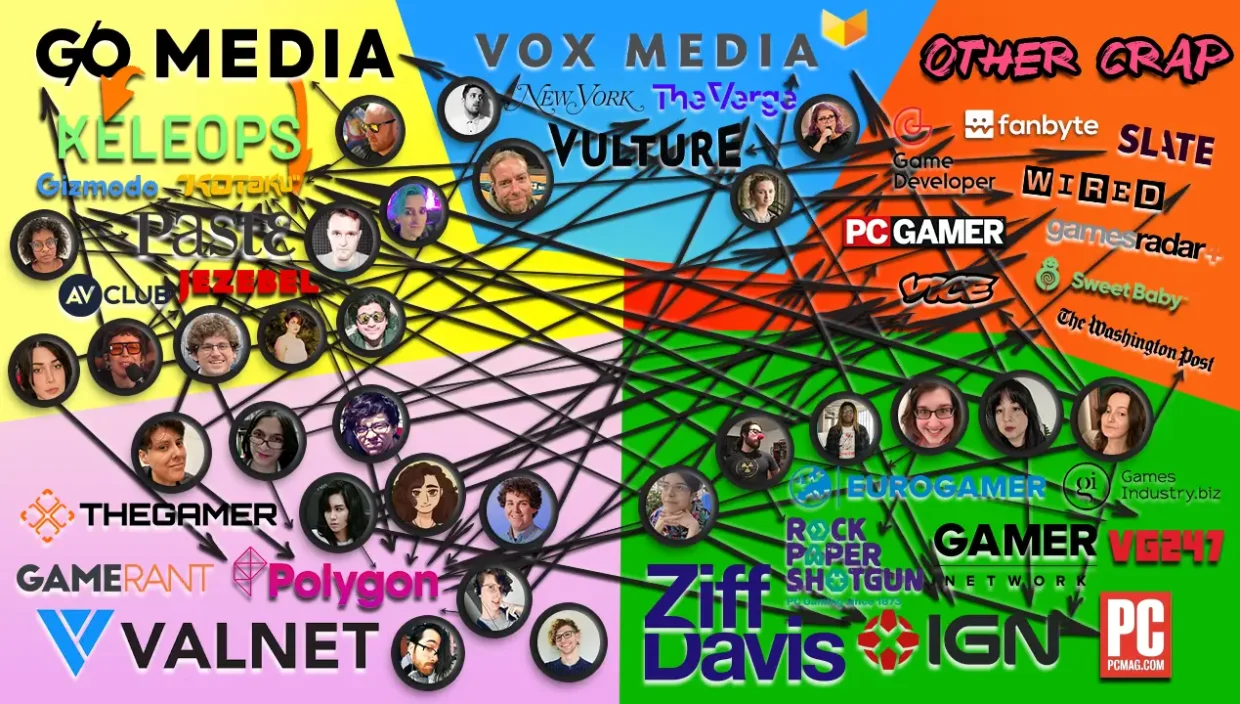
Some of Aftermath’s Contributors’ Former Experience | Some Publications Were Left Out for Space Considerations and Sanity Retention
This is not accidental. These outlets didn’t just hire the same people. It appears to me like they’ve actually cultivated a shared editorial culture of progressive brainrot.
That culture seems to prize heavy emphasis on cultural commentary, strong ideological framing, a tendency to over-moralize audience disagreements, and an increasingly adversarial relationship with the actual gaming communities that they were supposed to be a part of.
And if you’re not part of their merry band of nose-ring wearing rascals – you’re considered to be “alt right bigot grifters”, because that’s obviously that’s the only explanation for not agreeing with them.
But when those funderful institutions began collapsing left and right under their shrinking readership, declining trust, and internal conflict, the staff didn’t just accept get banished to the shadow realm.
They regrouped.
Aftermath is not some outsider challenging games media…it’s the continuation of it, just reassembled under a different banner like some sort of unwanted journalistic Temu Voltron.
Corporate Media Didn’t Poof Away in a Vacuum
It’s tempting to just frame the downfall of mainstream games media as purely a corporate failure. Greedy owners, bad management, soulless ad models – and sure, those things absolutely played a role.
But that explanation conveniently ignores a harder truth. Audiences didn’t just leave because of ads or SEO slop. They left because they stopped trusting the media.
Over time, players felt like games journalism became less about games and more about stirring the pot, social justice brownie points, and lecturing an audience assumed to be either bigoted or even dangerous.
That idea didn’t just pop out of nowhere though.
It was reinforced through coverage choices, social media behavior, comment moderation policies, and an ever-growing disconnect between what gamers cared about and what journalists wanted them to care about.
And then when readership started tanking, the response wasn’t reflection. It was deflection.
All of a sudden, gamers weren’t rightfully unhappy – they were labeled “toxic”. Criticism wasn’t feedback anymore – it was “harassment” and “review bombing”. The audience didn’t disagree either – they just simply “didn’t understand”.
The cope was crazy and it was just not a good recipe for longevity.
Aftermath Appears as Legacy Media Vanishes
Okay, so this is where Aftermath finally fits into the bigger picture.
It’s not a startup born from new voices, new perspectives, or some new trust-building strategies. It is a reconsolidation of journalists shaped by the same institutions that already lost cultural relevance.
The pitch is familiar:
We are independent now.
We are reader-funded.
We are finally free to be honest.
But honesty without being able to take a good hard look at yourself is just hubris.
Aftermath’s editorial philosophy explicitly rejects the idea of neutrality in favor of strongly voiced perspectives. Basically, the same thing they complained about not being able to do when G/O Media told Kotaku to shut the hell up and write some game guides in 2024.
And that’s not inherently wrong, but it is also not anything new. It’s the same exact approach that basically defined most of the 2010s gaming media (at the height of woke cancel culture), now just repackaged as authenticity instead of advocacy.
If gamers didn’t want to listen to it then, I don’t really understand why you think they will now.
Reader-Funded Doesn’t Mean Gamer Aligned...
In my humble opinion, one of the most ironic elements of modern “independent” journalism is how just insulated it is.
When revenue comes from a small, ideologically aligned subscriber base instead of a broad audience, incentives shift. The goal is no longer persuasion or exploration. It just becomes reinforcement. Because actually challenging assumptions risks churn. Engaging with unbiased critics that aren’t part of your little social circle risks conflict. So it’s just safer to double down on all of your previously established position, right?
The problem is – that dynamic doesn’t actually fix your trust problem. It just hardens it.
Gamers who already felt ignored or talked down to by legacy media aren’t going to just resubscribe simply because the same voices now own the platform instead of a corporation.
Your voices were elevated by that same corporation!
Independence doesn’t just magically gift you relatability with gamers, especially when the tone and framing of your content remains exactly the same as it did five years ago.
The Familiar Pattern of Media Reboots
And we’ve seen this same strategy before, not just in journalism but across gaming media in general. All of a sudden when a brand falters, familiarity is treated as some substitute for actual relevance.
That one-dimensional instinct often leads to buyouts, “spiritual” successors, or some sort of nostalgia-vomiting revivals. Basically, attempts to preserve their lost identity rather than actually try to evolve it.
And I’ll say that sometimes it works (sorry Giant Bomb, not talking to you). But more often than not, it just doesn’t.
What remains consistent is the absolutely delusional assumption that the audience just magically left because of some nefarious external forces, but definitely not because of the content itself.
And to me, Aftermath just feels like another entry in that pattern.
It rests on the belief that the problem was corporate ownership, not editorial direction. Advertising, not audience alienation. Capitalism, not credibility.
So What's Actually New in Aftermath?
Strip away the branding and the rhetoric, and what’s left?
A familiar roster of writers.
A familiar ideological lens.
A familiar dismissal of genuine gamer criticism.
A familiar insistence that the audience is the actual problem.
The only real difference – the business model.
And that is the core issue. Aftermath wants to be treated as a fresh start without acting like one.
A genuinely new voice in games media would look…uncomfortable. It would probably argue internally. It would almost invite dissent. It would prioritize the long-lost gameplay and player experience without trying to frame disagreement as if it was some sort of moral failure.
It would actually try to rebuild trust instead of demanding it.
Aftermath does not do that, and I think it’s because it doesn’t really see a reason to try.
A Reboot, Not a Reinvention
Aftermath may succeed as a niche liberal publication supported by a specific readership and pushed forward by their connections they already have in legacy gaming…who knows. But positioning Aftermath as if it’s somehow the future of games journalism ignores a basic reality…you’re all just relics of the past.
Gamers did not reject games media because it wasn’t “independent” enough. They rejected it because of writers like the ones comprising Aftermath felt alien, dismissive, and uninterested in meeting gamers where they were.
If Aftermath truly wants to be different in the future, I honestly think it will need more than just a new business structure and a familiar staff…it’s going to need to come to terms with why the old model failed and why so many players walked away without ever looking back.
Until then, it just doesn’t feel like a fresh start.
It feels more like opening a box to find some old shoes that you could have sworn you already threw into the trash.
This was a commentary article based on publicly available information and personal opinion. Readers are encouraged to form their own conclusions based on the sources cited.
All images, logos, and video clips used in this article are the property of their respective owners. This content is used for the purposes of commentary, criticism, and news reporting under the guidelines of Fair Use (17 U.S.C. § 107). No copyright infringement is intended. If you are the copyright holder and believe your content has been used improperly, please contact us directly.
Want More?
Check These Out Next!

About Report AFK
A place for gamers, by gamers, untarnished by corporate gaming media and their nonstop attempts to elevate bad games while denouncing any developers brave enough to stand up to them.
Site Links

Copyright 2026 ReportAFK.com
Solid Snake
January 29, 2026
Dammmnnnnn shots fired!
Ayefkay
January 29, 2026
Lol come on, they deserve it. Thanks for stopping by Snake!
Shannon R
January 29, 2026
ive never heard of 90% of the people mentionedhere
Ayefkay
January 29, 2026
Unfortunately, I have. And you’ve probably read or seen a lot of their crap without realizing it. They basically have infected every corner of gaming media.
Thanks for dropping by Shannon!