



- arrow_back Home
- keyboard_arrow_right Gaming News
The “Modern Audience” Never Came: 1348 Ex Voto Flops Hard
Gaming News 41 6 Ayefkay March 14, 2026
If you spent any time on gaming X/Twitter over the couple of months, you’ve probably seen the usual suspects like PC Gaymer and IGN hyping up 1348 Ex Voto as the next big medieval game.
According to the team’s marketing push, it had supposedly huge wishlist numbers, a passionate following, and a story crafted specifically for the mysterious “modern audience” that developers and journalists love to talk about.
Then the game launched.
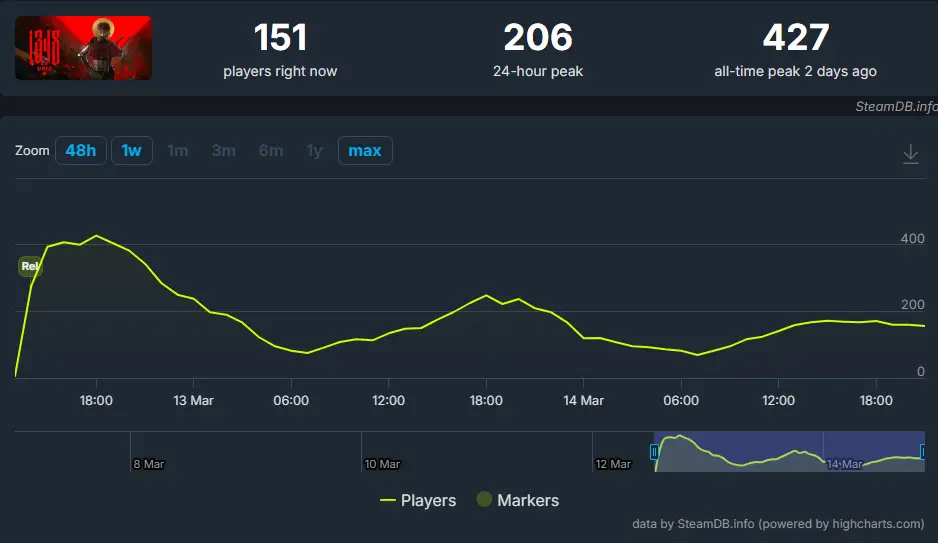
Reality showed up fast and without mercy. According to our beloved charts tracked by SteamDB, the game barely managed a 427 player peak on Steam during its launch day.
Again, that’s four hundred. And twenty seven people. That is not a thriving medieval kingdom of players. That’s probably closer to the headcount of a local bowling league or something.
The funniest part though, in my humblest of opinions, is that absolutely none of this came out of nowhere. Anyone who bothered to look at the numbers ahead of launch could already see the storm clouds rolling in.
The hype surrounding 1348 Ex Voto never lined up with the data sitting right there on its own Steam page, and once people started noticing the obvious gap between the spoonfed marketing narrative and the actual interest, the whole situation started looking just a little more…funderful.
Feel free to read through the whole thing or click on an ADHD navigation link below:
The Wishlist Girl Math Just Never Made Sense
Okay so before launch, the devs and some completely unbiased and definitely not ideologically -captured gaming media outlets proudly proclaimed that 1348 Ex Voto had passed 100,000 wishlists, with later announcements pushing that absolutely not fictitious number to even higher echelons, reaching over 250,000!
Congrats, because those are some big numbers for an indie title! There’s no way for us peons to verify that number, of course, because that data isn’t public, and usually that kind of interest translates into strong demo participation and a healthy launch.
But that’s where things kinda started getting a bit…weird.

1348 Ex Voto 250K Bots Wishlisted | Press X to Doubt
On Steam, one of the easiest ways to gauge interest in a game is the number of followers on the game’s hub page. To be clear, wishlists and followers are not identical, but they do usually trend in the same general direction. So if a game truly has hundreds of thousands of people waiting with bated breath to buy it, the follower count is rarely sitting in the low thousands.
But the Steam page for 1348 Ex Voto showed roughly 12,000 followers…
Twelve thousand followers paired with claims of hundreds of thousands of wishlists is the kind of bad math that will make some people raise an eyebrow. That mismatch started circulating around online long before the game released, and the numbers only got more confusing when the demo dropped.
Because when the demo came out – 1348 Ex Voto’s demo peaked at only 167 concurrent players.
For a supposedly hyped medieval RPG, that number felt less like an exciting preview event and more like a small activist book club. Even more modest indie game titles usually attract far more traffic when they release a playable slice of their pie. Instead, the demo quietly slipped into Steam with barely enough players to fill a small Discord server.
So at that point (at least to me), the launch trajectory of this game looked pretty damn obvious.
When Social Media Drama Becomes Marketing
But of course – instead of easing the tension or trying to clarify the whole wishlist situation, Sedleo decided to take another approach and instead leaned hard into the chaos online.
Back in January, the official account took a jab at the similarly themed indie project Knight’s Path, telling people to wishlist the game and mark the release date on their “Modern Agenda.”
If you happen to have spent more than five minutes online though, you already know what happened next.
Don’t forget to wishlist and note the release date on your Modern Agenda. ❤️ https://t.co/EU44XPml9A
— 1348 Ex Voto (@1348ExVoto) January 23, 2026
With the ragebait trap set, arguments erupted immediately. Threads exploded. People took sides. Some defended the game while others mocked the hell out of it. A few professional internet asshats tried to spin the entire thing into the latest culture war battlefield, while of course, staying as unbiased as possible to maintain their typical level of professionalism.
From a marketing standpoint though, the strategy is obvious.
Smack the bee’s nest, attract attention, and hope the controversy brings new eyes to the product. Outrage spreads pretty quickly on social media, and developers sometimes hope that the attention will translate into curiosity.
The problem is that outrage does not automatically convert into sales. A wee bit of attention might feel great for engagement metrics, but in actuality – those numbers live in a completely different universe from player counts.
Retweets are funsies.
Wishlists are promising.
But the only number that truly matters arrives on launch day when players decide whether or not they are actually going to spend their money on your game.
But What About The Modern Audience?!
For several years now, a familiar phrase has seemingly floated around interviews and press previews. Developers talk about building games for the “modern audience.” Journalists parrot the phrase when discussing narrative direction or character design. Marketing teams use it as some sort of badge of honor.
And sure, the idea probably sounds appealing.
Games want to evolve with the times. Stories want to grow alongside new perspectives. None of that is particularly controversial.
But what keeps raising questions is that the strange gap between online seal clapping and the actual sales numbers when these projects finally release.
Some of the “wokies greatest hits” over the past few years sparked similar debates: Concord generated endless…constructive criticism (?) before players got their hands on it. Other amazing-and-definitely-not-hot-garbage-titles like Assassin’s Creed Shadows also stirred up massive debates about ideological direction and developer liberties taken when it came to historical accuracy.
Social media reactions were loud. Comment sections were packed with opinions. Yet when the dust settles, the metric that really decides a game’s future is painfully simple.
Did people actually buy the game?
For 1348 Ex Voto, the modern audience appears to have skipped the launch party entirely.
Again.
LGBT Stuff Can Exist: Why Baldur’s Gate 3 Worked
Whenever these debates start spiraling, one obvious example tends to get overlooked. Baldur’s Gate 3 became one of the biggest RPG success stories in recent memory and let’s be honest – it was woke af.
It swept award shows, dominated Steam charts, and pulled in millions of players across multiple platforms. The game included gay romance options and a mountain of sotry choices that allow players to shape their own story.
You may be asking, why am I not slamming on Baldur’s Gate 3 then? There’s one huge difference between Baldur’s Gate 3 and the rest of the woke propaganda:
Everything exists as a choice.
Nothing forces the player down a single ideological lane. If you want to explore those storylines, the game lets you do it. If you would rather ignore them and focus on adventuring with your party as a straight white dude accidentally launching goblins off magically serene cliffs – the game happily supports that too.
Player freedom sits at the center of the experience.
Contrast that approach with hilariously woke moments in Dragon Age: The Veilguard where certain conversations push the player toward very specific (and incredibly nauseating) responses in discussions about the characters’ supposed “identity”. When cringe dialogue options narrow your experience into a single, corporate-approved reaction, the illusion of RP starts gets immediately yeeted out the window. Instead of exploring a world, the player begins to feel like they are sitting through a scripted morality lesson. And trust me, that’s the intention.
I would like to think that most people (at least myself) don’t definitively hate having some LGBT options in games (if done correctly and in moderation), but what they absolutely won’t stand for and can see through every time is the half-assed writing around a specific theme that let’s you know that game is telling you how you are supposed to think and feel.
Sorry, not sorry.
The Narrative vs. The Numbers
Gaming media often likes to proclaim that these projects are bold creative steps forward from the tallest peaks until your ears bleed. Articles highlight the approved themes, messages, and ambitions behind the devs’ storytelling. The goal is to basically build their own narrative around the game long before players ever interact with it.
Then launch day arrives and the Steam charts start telling their own story. The thing is, Steam regularly hosts almost 70 million players across the platform. Daily.
Against that massive audience, a launch peak of a few hundred players barely registers as a blip. Yet the surrounding hype online (fabricated or not) can make it sound like some sort of amazing cultural milestone.
But that disconnect is exactly where the frustration starts creeping in for a lot of players.
When gamers constantly hear that certain games are “groundbreaking” while the actual player counts clearly show otherwise, the credibility of the critics and media starts to implode.
FAQ
What is 1348 Ex Voto?
1348 Ex Voto is another wannabe indie medieval RPG that is set during the time of the Black Death. It launched on PC through Steam in 2026 and has been steeped in controversy for months due to it’s woke themes and alleged ESG funding.
Why are people talking about the 1348 Ex Voto player count?
Discussion around the game largely centers on its launch numbers, because compared to their claims of wishlists – they’re basically non-existant.
According to tracking data from SteamDB, the game peaked at around 427 concurrent players shortly after release. That number is in stark contrast to what had been previously promoted to the game having very high wishlist totals.
How many wishlists did 1348 Ex Voto claim to have?
Prior to launch, marketing and online discussion suggested the game had well over 100,000 wishlists, with that number being further inflated to 250,000 closer to the time of release.
Wishlist numbers are often used as a signal of early interest, however are conveniently not available to the public, which is why the relatively low player counts sparked debate among players.
Do Steam wishlists usually convert into sales?
Wishlists can usually be considered at leasdt a strong indicator of potential sales.
Many developers estimate that 10% – 20% of wishlists convert into purchases around launch, although the exact number obviously varies depending on marketing, reviews, and overall interest. Because of that typical conversion range, some players questioned why the launch numbers for 1348 Ex Voto appeared much lower than expected…
What is meant by the “modern audience” in gaming discussions?
The mythical “modern audience” is commonly used in developer interviews and gaming media when discussing evolving storytelling themes, representation, or design philosophies aimed at the newer generation of players.
The term can mean different things depending on the context, which is why you can see it often becomes a point of debate among gamers.
Are there any legit comparisons to Baldur's Gate 3?
I don’t know if I would say that anyone would compare the two, besides the fact that both games had LGBT-LMNOP representation, however BG3 is frequently referenced in conversations about player choice and narrative design.
Why is Dragon Age: The Veilguard sometimes brought up in these debates?
While definitely a closer comparion than BG3, Dragon Age: The Veilguard is often mentioned in discussions about what not to do in RPGs.
Do player counts always determine a game’s success?
Concurrent player numbers can give a snapshot of interest at launch, but they are not the only factor that determines long-term success.
Some games grow over time through updates, word of mouth, or major patches. However, early player counts can often influence public perception and can really affect how quickly a game builds momentum.
Gamers Still Have the Power...To the Media's Dismay
At the end of the day, the funderful world of gaming remains brutally straightforward. Players reward the games that they enjoy with $$$ and ignore the ones that they don’t like.
Marketing teams can try to generate hype.
Gaming media can try to run defense.
But nothing that the media or devs try to pull can guarantee a game’s actual successful launch. The only real scoreboard sits on Steam’s storefront – where players decide what deserves their time and money.
And unfortunately for 1348 Ex Voto, that scoreboard is probably looking pretty damn depressing. The “massive wishlist” claims collided with the reality of a launch that barely crossed even four hundred concurrent players and that gap is honestly too difficult to ignore, no matter how many articles the gaming media tries to use to spin the narrative.
But just wait – I can 100% guarantee you that they’ll be blaming gamers again for the game’s failure…per usual.
But honestly, developers who are honestly looking for the opinion and feedback of actual money-spending gamers do not need surveys or hashtags.
They just need to check the player count.
It may not be the answer they hoped for, but the numbers rarely lie.
This was a commentary article based on publicly available information and personal opinion. Readers are encouraged to form their own conclusions based on the sources cited.
All images, logos, and video clips used in this article are the property of their respective owners. This content is used for the purposes of commentary, criticism, and news reporting under the guidelines of Fair Use (17 U.S.C. § 107). No copyright infringement is intended. If you are the copyright holder and believe your content has been used improperly, please contact us directly.
Want More?
Check These Out Next!

About Report AFK
A place for gamers, by gamers, untarnished by corporate gaming media and their nonstop attempts to elevate bad games while denouncing any developers brave enough to stand up to them.
Site Links

Copyright 2026 ReportAFK.com
Phoebe
March 14, 2026
too funny iol
lissa
March 14, 2026
go woke go broke
Mario
March 15, 2026
Yeah I will never play this garbo
Jermaine
March 15, 2026
Why do they keep making games like this??
J
April 8, 2026
and no one was suprised at all
📊 Withdraw 1,824269 BTC. Next >> telegra.ph/COMPENSATION-05-12-9?hs=7c7f8ff33eb3a24ad954edd1aa0f6e5b& 📊
June 28, 2026
z4laeh